
Interpreting Byzantine Art and Recovering Access to Meaning at Antivouniotissa Museum
Antivouniotissa Museum, Corfu, Greece.
Former church dedicated to Our Lady of Antivouniotissa.
Artwork discussed: Descent into Hell (first quarter of the sixteenth century), attributed to Iakobos, Cretan School.
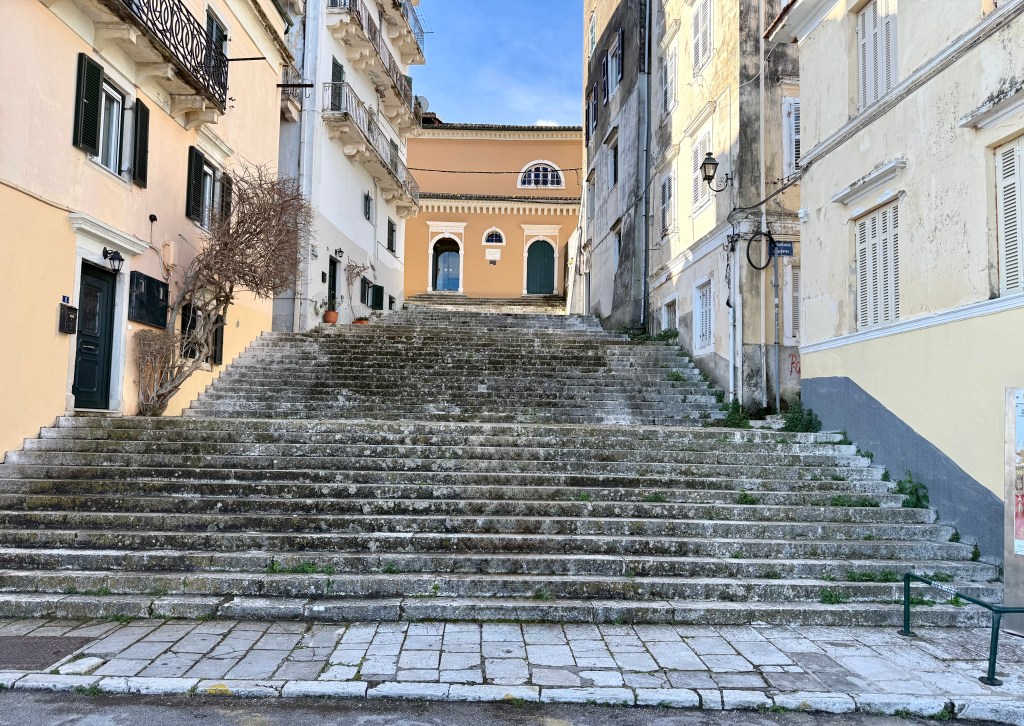
More than twenty steps appear before me.
—Could this be the Byzantine art museum I have been looking for?
I begin to climb.
Gradually, I approach the main entrance: two twin doors—one protected by a glass enclosure—perfectly aligned with the staircase connecting the coastal street to the old church. As I move upward, the change in elevation transforms the perspective and, from inside, the sea becomes part of the visual journey.
Today, few things fascinate me more than encountering a work of art in the place for which it was originally conceived.
At the heart of the former church dedicated to Our Lady of Antivouniotissa, an important collection of icons and devotional objects dating from the fifteenth to the twentieth centuries has been preserved, representing both the religious art of Corfu and the development of the Cretan School.
Entering this museum means entering an atmosphere more than a collection.
A slower rhythm. Silence. Icons still occupying positions connected to their original liturgical function.
Among the works displayed in the northern narthex of the church—a transitional space between the exterior and interior of the temple—one unexpectedly stopped me.
With no more information than a title in English and Greek and an approximate date:
“Descent into Hell – First quarter of the sixteenth century”.
I remained standing before it, trying to understand what I was seeing.
A central figure. The resurrected Christ surrounded by a luminous almond-shape aureola (mandorla). Darkness opening beneath his feet. An elderly man whose hand was being held. And beside him, a figure covered in a red mantle.
My eyes searched for relationships. Nothing appeared immediately. It was not a lack of interest. It was something else.
For several minutes, I remained silent before an image that seemed to contain a meaning to which I did not yet have access.
When Looking Is Not Understanding

Descent into Hell (first quarter of the sixteenth century), attributed to Iakobos, Cretan School.
Why did this image remain partially inaccessible to me despite my interest in Byzantine art?
I could recognize its religious character.
I could recognize beauty.
I could recognize intention.
But recognition is not the same as understanding.
Many historical works belong to symbolic systems whose codes contemporary audiences no longer fully share. This does not mean that the work has ceased to communicate.
Perhaps silence emerges precisely there: in the space that opens between the image and the person attempting to interpret it.
A Small Act of Interpretation Changes Everything

After moving through the museum spaces—the nave, central hall, and gallery/narthex—I could no longer resist asking about the meaning of the work that the museum identified as Descent into Hell. The person in the entrance hesitated before answering.
After a long silence, opened a book written in Greek. Only a few words emerged:
Jesus.
Adam and Eve.
Beelzebub.
Sarcophagus.
Those few words reorganized the image.
What had initially appeared to be a collection of isolated visual elements suddenly became a narrative.
The narrative of Christ’s Resurrection represented through the visual language of Byzantine art: the iconographic tradition more commonly refers to this scene as Anastasis or Christ’s Descent into Hades. The resurrected Christ does not emerge from the tomb; instead, he descends into the underworld as a symbol of victory over death and redemption for humanity.
The elderly figure became Adam.
The covered figure, her arms hidden beneath a red mantle in a gesture of supplication, became Eve.
Both wait for salvation. Salvation brought by Christ within the luminous mandorla, which in Byzantine art symbolizes passage: a threshold between realities.
At the lower register appears a defeated dark figure—often interpreted in Byzantine iconography as Hades, Death, or the defeated powers of the underworld. The scene ceased to be static.
Meaning began to move. Interpretation did not simplify the image. Interpretation restored relationships.
What Is Silence Before Art?
Perhaps silence in museums is not always contemplation. Sometimes silence emerges when interpretation has not yet begun. We may distinguish at least three possible forms of silence.
1. Silence as reverence
Silence may be understood as an inner disposition of availability, respect, and openness toward something we feel deserves contemplation before immediate understanding.
In other words, the work generates an experience that exceeds language, and silence appears as a contemplative response: even without fully understanding, we remain willing to stay.
In Byzantine art, for example, silence becomes an experience of encounter in which the artwork transforms into a space; a kind of window toward a deeper reality.
In Descent into Hell, silence acquires another nuance.
Traditionally, the Byzantine icon is not simply looked at as an aesthetic object; it is contemplated.
Silent reverence implies:
- suspending judgment,
- reducing interior noise,
- entering into presence.
It is not emptiness.
It is attention.
This may explain why, in many Orthodox spaces, the icon naturally coexists with silence: because it is understood as a window onto another order of reality.
2. Silence as saturation
Some works of art exceed—or can exceed—the limits of our interpretive capacity.
This may happen because the work offers more meaning, more information, or more symbolic structures than we are able to process at once.
This is a silence produced by excess.
There are so many layers of meaning—signs, symbols, images—that interpretation becomes temporarily suspended.
Something similar occurs with works that occupy almost the entirety of our bodily field of experience, as happens with site-specific frescoes, Byzantine icons, or works in which art becomes less an object than an event.
Silence may also emerge as a discursive limit: there are so many relationships to establish that silence temporarily covers the attempt to create meaning within what feels like a labyrinth or a puzzle.
Returning again to Descent into Hell, silence as saturation may appear when we recognize that the image contains too many simultaneous layers:
- descent and ascent,
- death and victory,
- darkness and illumination,
- historical time and eternity,
- movement and stillness,
- humanity and divinity.
The eye moves from one figure to another but never reaches completion.
In this sense, silence would not be reverence alone.
It would also become a form of interpretive expansion.
3.Silence as interpretive distance
In this case, silence emerges as the consequence of a decision—conscious or not—to keep the production of meaning open.
Rather than rushing toward immediate interpretation, silence acknowledges the polysemy of the artwork: the possibility of revisiting signs and reopening interpretations.
It means listening to the work rather than confirming what we already bring with us.
It begins from the assumption that meaning is not extracted from the artwork but progressively discovered.
Thinking again of Descent into Hell, interpretive distance might mean resisting immediate historical or iconographic questions (“Who is each figure?”) and instead first observing:
- Where does the composition move?
- What relationships are created through the gazes?
- What tension exists between descent and elevation?
- What does the gold background do to the experience of time?
Only afterward would interpretation begin.
From these three possible distinctions of silence, a broader question emerges:
How do contemporary audiences reconnect emotionally with symbolic systems belonging to other historical moments?
Why Context Matters
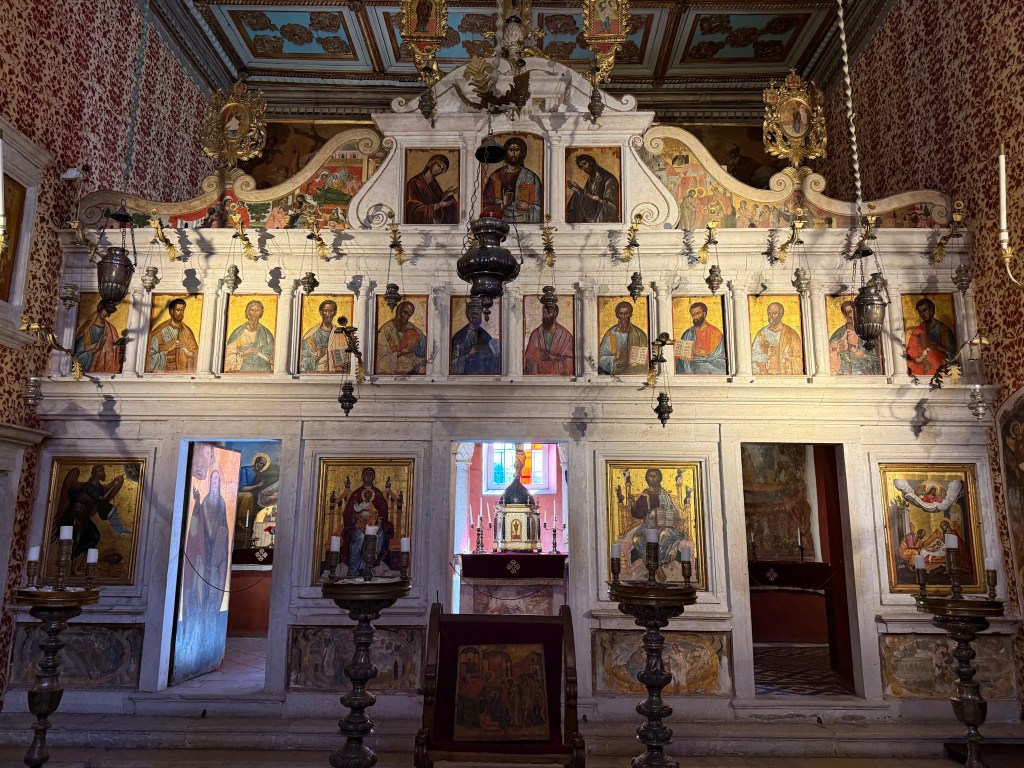
Why, in spaces such as the Antivouniotissa church-museum, does the meaning of artworks not reside solely in the image?
Because here the artwork does not function as an isolated sign.
Its meaning emerges from a network of relationships among image, architecture, ritual, and historical memory that shapes both how we look and how we interpret.
Visiting Antivouniotissa means entering a space that still preserves part of its original function as a sacred place.
The route through the building, the filtered light, the silence, and the arrangement of the icons organize the visitor’s experience even before a specific work is observed.
In the central space, the altar continues to structure vision.
Architecture guides bodily movement and distributes attention: from the entrance toward a point of visual culmination where images acquire meaning in relation to one another.
Christ Pantocrator, the Virgin, John the Baptist, the apostles, and the hierarchical arrangement of the ensemble do not appear as independent images, but as part of a visual sequence that articulates a spiritual and narrative experience.
In this sense, architecture also interprets.
The dim light, the predominance of gold, and the height of the space do not merely create an aesthetic atmosphere; they produce the conditions for contemplation.
Even if the images were temporarily removed, we would probably continue to perceive the site as sacred.
Meaning begins to take shape before the encounter with the artwork itself.
Another fundamental dimension must also be considered: ritual.
In Byzantine art, icons were historically not created simply to be observed.
Their meaning was completed through specific practices: prayer, bodily movement, liturgical time, communal repetition, the lighting of candles.
Meaning was not contained exclusively within the image; it was continually actualized through use.
When these objects enter the museum, part of the ritual disappears, but interpretive traces remain.
Memory also remains.
Antivouniotissa exists within a territory shaped by centuries of cultural exchange between East and West.
Corfu became a meeting point between Byzantine, Venetian, and Greek traditions and received part of the Cretan artistic legacy following the fall of Crete in the seventeenth century.
Each of those historical layers remains silently embedded within the works.
For this reason, when observing Descent into Hell, we are not contemplating only a religious scene.
We also encounter a historical way of understanding time, salvation, the body, and the relationship between image and transcendence.
This possibly reveals something important for thinking about art today:
meaning is not a fixed property of the artwork.
It emerges through the encounter between what we see, the context in which it appears, the practices surrounding it, the memories it activates, and the interpretive disposition of the observer.
As I left Antivouniotissa, I found myself thinking that contemporary audiences may not necessarily need simpler versions of historical art.
It is possible what we need are forms of mediation that allow us to enter complex symbolic worlds without reducing them.
Those few words spoken in front of the icon—Descent into Hades. Christ. Adam and Eve.—did not answer all my questions.
Nor did they exhaust the work.
But they did something more important: they transformed silence into the possibility of encounter.
The image ceased to appear as a closed system and gradually became a conversation.
This is where access to art begins—not when we fully understand a work, but when someone—or something: a guide, a text, a space, a question—offers us an entry point sufficient to remain within it.
And perhaps this is one of the great contemporary challenges facing museums and cultural institutions today: not merely facilitating access to images but helping us recover access to symbolic worlds whose languages no longer feel immediate.
Because distance from historical art is not produced by indifference. It begins in silence.
And that leaves me with another question I am not yet ready to answer:
What kinds of silence still remain inside the works we believe we have already learned to see?

 The Lexel Journal